N7744T Crashes Near Deer Valley Airport After Reported Engine Trouble
On the morning of March 4, 2026, a small training aircraft crashed into a residential neighborhood in north Phoenix shortly after takeoff from Deer Valley Airport.
According to the Federal Aviation Administration (FAA), the aircraft—a Piper PA-28-140 Cherokee (registration N7744T)—went down around 7:20 a.m. near Cave Creek Road and Deer Valley Drive, just minutes after departure.
Early reports indicate the aircraft struck the roof of one home before coming to rest in the backyard of a neighboring property, leaving debris scattered across the residential area. Two homes sustained damage in the crash.
Three people were transported to a hospital following the incident: the flight instructor and student pilot onboard the aircraft, along with a resident inside one of the impacted homes. All were reported to be in stable condition with minor injuries, according to Phoenix Fire Department officials. The identities of the instructor, the student pilot and the resident have not been publicly released as of the initial reports.
Federal investigators from the FAA and National Transportation Safety Board (NTSB) have launched an investigation into what caused the aircraft to go down.
N7744T Phoenix Plane Crash: Crash Analysis & Legal Implications

Observations from an Aviation Attorney & Pilot
In a detailed breakdown of the accident, Ramos Law’s Director of Aviation Joe LoRusso (a professional pilot and aviation accident attorney) outlined the sequence of events leading up to the crash.
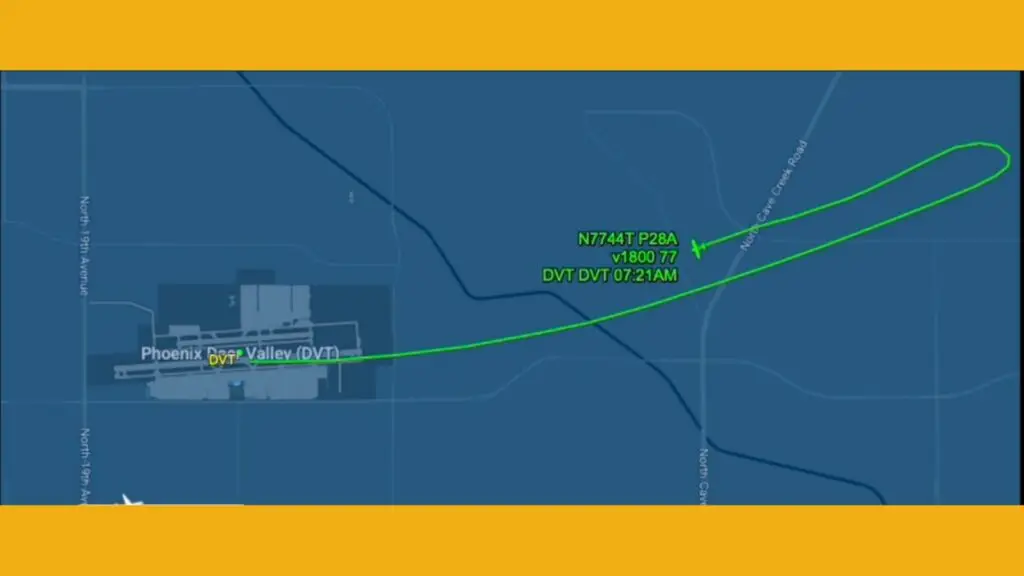
“From what we know so far, it appears N7744T departed from the Phoenix-area airport Deer Valley,” LoRusso explains. “The Cherokee climbed eastbound for about four miles and then abruptly turned left and began a descending turn back toward the airport.”
The aircraft ultimately failed to reach the runway and crashed into a nearby neighborhood, coming to rest against a house approximately two to three miles east of the airport. Early reports indicate the aircraft struck the roof of one home, shearing off part of a wing, before coming to rest nose-down in the backyard of a neighboring property.
Despite the dramatic impact location, LoRusso emphasized the remarkable outcome.
“Fortunately, the two people onboard, believed to be an instructor and a student, walked away,” he says. “This is one of the good days in aviation crash law where I don’t have to discuss a fatality.”
Air Traffic Control Response During the Emergency
Air traffic control communications indicate the aircraft initially departed Runway 7R at Deer Valley Airport and was cleared to proceed on course.
Shortly after takeoff, the pilot contacted the control tower with urgency.
According to LoRusso, the pilot reported engine issues and low RPM, suggesting a loss of engine power.
“Tower then cleared the aircraft to land and told the pilot they would ‘roll trucks,’ meaning emergency vehicles were being dispatched to the runway,” LoRusso explains.
Controllers also worked quickly to move other aircraft out of the area and clear the approach path for the struggling plane.
However, the aircraft never reached the airport.
When the pilot stopped responding to radio calls, air traffic control requested nearby aircraft and a police helicopter to help locate the missing plane.
“Several minutes later, a helicopter located the aircraft leaning up against the side of a house,” states LoRusso.
He praised the controller’s response during the unfolding emergency:
“She did an absolutely phenomenal job handling the emergency—clearing traffic, coordinating emergency vehicles and directing other aircraft to help locate the crash site.”
What Type of Aircraft Is the Piper PA-28 Cherokee?

The aircraft involved in the crash was a Piper PA-28-140 Cherokee, a widely used single-engine aircraft commonly employed for pilot training and personal aviation.
First introduced in 1960, the Cherokee series is known for its simplicity and reliability. Typical characteristics include:
- Four-seat configuration
- Fixed landing gear
- Single piston engine
- Cruise speeds around 120 knots
- Common use in flight training programs
Because of its relatively forgiving flight characteristics and straightforward systems, the PA-28 remains one of the most common training aircraft operating in the United States.
Caused the Crash? What May Have
While investigators have not determined an official cause, the pilot’s radio call reporting “low RPM” may provide an important starting point for investigators.
“In cases like this, when a pilot clearly reports a power issue, we often begin the investigation by examining the aircraft’s powerplant,” says LoRusso.
Potential areas of investigation may include:
- Engine or powerplant component failure
- Fuel system issues
- Maintenance or inspection errors
- Fuel starvation or fuel contamination
Investigators will likely examine maintenance records, aircraft logbooks and any recent repairs or inspections performed on the aircraft.
Aircraft Maintenance and Recent Sale Questions
Early indications suggest the aircraft may have recently changed ownership, which could play an important role in the investigation.
“When an aircraft is newly purchased, investigators will want to know whether a pre-purchase inspection was performed and who conducted it,” LoRusso explains.
He also noted that aircraft which fly infrequently can sometimes develop mechanical problems.
“Airplanes need to be flown,” he says. “If they sit too long, seals dry up, hoses fail and components can deteriorate.”
Maintenance records and logbooks will be closely examined to determine whether any mechanical issues existed prior to the crash.
FAA and NTSB Investigation Process
The National Transportation Safety Board (NTSB) holds congressional authority to investigate aviation accidents in the United States. However, in many general aviation crashes without fatalities, the agency delegates on-scene investigative work to the FAA.
“In most cases like this, the NTSB will delegate the investigation to the FAA,” LoRusso explains.
Two divisions of the FAA may become involved:
Flight Standards District Office (FSDO)
Investigators from the local FSDO will examine:
- Aircraft airworthiness
- Maintenance and inspection records
- Pilot certifications and training
- Operational compliance
FAA Aeromedical Certification Division
Because the crew survived the crash, the FAA may also review their medical status.
The agency can request medical documentation, including hospital records and physician evaluations, to determine whether the pilots remain medically qualified to fly.
A preliminary report may be released in the coming weeks, while a final probable cause determination could take one to two years.
Potential Legal Claims After a General Aviation Crash
While the investigation is ongoing, several potential legal issues could arise depending on the findings.
LoRusso notes that many aviation cases involve either maintenance negligence or defective aircraft components.
However, aviation product liability claims are often affected by a federal law known as the General Aviation Revitalization Act (GARA).
GARA generally prevents lawsuits against aircraft manufacturers for aircraft or components more than 18 years old, unless a newer replacement component contributed to the crash. However, the statute includes a “rolling provision,” meaning newer replacement parts installed within the last 18 years may still create potential manufacturer liability.
“In a case like this, the maintenance logs will be scrutinized closely,” LoRusso explains.
Investigators may examine whether recent parts or maintenance procedures played a role in the power loss.
Insurance Questions After Aviation Accidents
General aviation insurance policies can also complicate crash claims.
“The most common general aviation policy is what’s called a ‘one hundred thousand per seat, million aggregate’ policy,” LoRusso explains.
That means:
- Maximum $100,000 coverage per passenger seat
- Up to $1 million total aggregate coverage
Interestingly, property damage claims (such as damage to homes struck by an aircraft) are often not limited to the per-seat cap, meaning homeowners may recover more compensation than passengers in some cases.
A Remarkable Outcome
Despite the severity of the crash and the fact that the aircraft struck multiple homes, the outcome could have been far worse.
“This really is one of those situations where it’s remarkable that everyone survived,” says LoRusso.
A baby’s bedroom in one of the homes was struck during the crash but fortunately no one was inside at the time, preventing what could have been a far more tragic result.
We Will Continue to Monitor This Story
The FAA and NTSB investigations remain ongoing as officials work to determine the exact cause of the crash.
Ramos Law will continue to monitor updates as investigators examine the wreckage, maintenance records and flight data.
If you or your family have questions about aviation accident investigations, aircraft liability or your legal rights following a crash, our aviation litigation team is available for a confidential consultation.
Our thoughts remain with those injured and the families impacted by this frightening incident.
Note: All reported details are preliminary and based on witness reports or publicly available information. Official findings will be determined by the investigating authority.
N7744T Crash Flight Details
Aircraft: Piper PA-28-140 Cherokee
Registration: N7744T
Date: March 4, 2026
Time: ~7:20 a.m. local
Location: North Phoenix, Arizona near Cave Creek Road and Deer Valley Drive
Departure Airport: Phoenix Deer Valley Airport (DVT)
Phase of Flight: Initial climb / attempted return to airport
Fatalities: 0
Injuries: 3 (student pilot, instructor, homeowner)
Aircraft Damage: Substantial
About Joseph LoRusso, Esq.
Joseph LoRusso is the Director of Aviation at Ramos Law and a nationally recognized aviation attorney with more than 20 years of hands-on flight experience. A professional flight instructor and Airline Transport Pilot, Joseph brings a rare dual perspective to every case—combining deep technical aviation knowledge with strategic legal advocacy for pilots, operators and crash victims.
Joseph holds multiple type ratings, including Learjet, Citation, Phenom 300E, Gulfstream GV (SIC), and L382 (C130) (SIC) and has flown complex missions as an atmospheric research pilot, including NASA’s 2018 CAMP2EX global campaign. Whether analyzing aircraft performance, regulatory compliance or crash causation, Joe approaches every case with precision, credibility and an unwavering commitment to achieving results for his clients.
Contact Ramos Law
Ramos Law’s Aviation Division focuses exclusively on aviation-related matters, including aircraft crashes, FAA enforcement actions, certificate issues and complex regulatory and operational cases. The practice is led by attorney Joseph LoRusso, a licensed pilot with real-world flight experience and deep knowledge of aviation regulations.
Our team understands the technical, operational and legal issues unique to aviation incidents. If you or your family has been affected by an aviation crash or regulatory matter, contact Ramos Law to speak with an aviation attorney who understands the industry.
Disclaimer: This article is intended for informational purposes and is based on preliminary reports and publicly available sources. Aviation accident investigations are conducted by the FAA and NTSB, and the official findings and probable cause will be determined by those agencies following a full investigation.
Piper PA-28-140 Cherokee FAQs
What type of aircraft was involved in the crash?
The aircraft was a Piper PA-28-140 Cherokee, a widely used single-engine plane commonly employed for flight training and personal aviation. It features a four-seat configuration, fixed landing gear and a single piston engine.
Were there any fatalities in the crash?
No. Fortunately, all three people involved (the flight instructor, the student pilot and a homeowner) survived. They sustained minor injuries and were transported to a hospital in stable condition.
What caused the Piper PA-28 Cherokee to crash?
The official cause has not yet been determined. Early reports indicate the pilot experienced engine trouble and low RPM shortly after takeoff. Investigators from the FAA and NTSB are reviewing maintenance records, the aircraft’s powerplant and other potential factors such as fuel issues or mechanical failures.
What is the FAA and NTSB investigation process for a crash like this?
The NTSB holds authority to investigate aviation accidents but may delegate cases without fatalities to the FAA. The local Flight Standards District Office (FSDO) typically examines aircraft airworthiness, maintenance and inspection records and pilot certifications. A preliminary report may be issued in weeks, while the final report could take one to two years.
Can homeowners or crash victims pursue legal action for damages?
Yes. Property damage claims, such as damage to homes struck by the aircraft, can often be pursued independently of passenger coverage limits. Potential legal claims may involve maintenance negligence or defective aircraft components, though federal laws like the General Aviation Revitalization Act (GARA) can impact lawsuits against manufacturers.

Experts in Aviation Law
Aircraft Crashes
Pilot Certificate Defense
FAA Medical Denial
FAA DUI Reporting
Civil Penalties
NTSB Appeals
And More!